


Highlighting the critical intersection of marine biodiversity conservation and indigenous cultural heritage, a research study conducted under the Institute of Fisheries (IoF) at Isabela State University (ISU) Main Campus has documented the species diversity and ethnobotanical value of wild seaweeds in the coastal town of Dinapigue, Isabela.
Titled “Diversity and Ethnobotany of Wild Seaweed Species in Coastal Barangay of Digumased, Dinapigue, Isabela, Philippines,” the study addresses the gap in comprehensive scientific documentation along Isabela’s Pacific coast. It also seeks to preserve the rapidly declining traditional ecological knowledge held by the indigenous Dumagat community.
High Species Richness Across Coastal Habitats
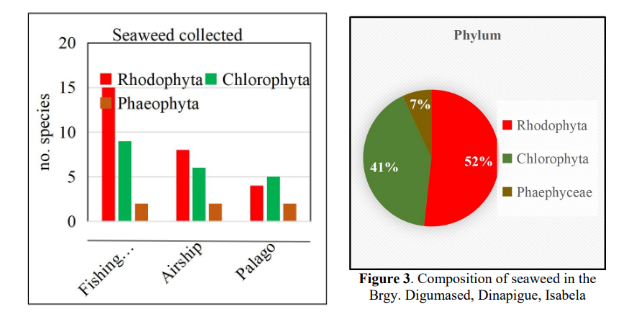
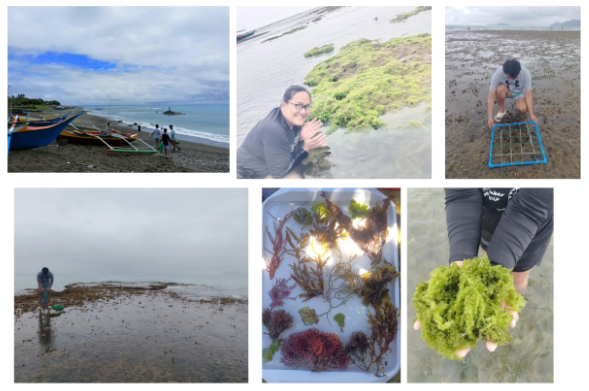
Conducted along the intertidal zone of Barangay Digumased between February and April 2025 during low tide, the research team identified a total of 29 wild seaweed species spanning three major phyla. The assessment was executed under DA-BFAR Region 02 Gratuitous Permit No. R02-0005-25, with wild Sargassum species documented strictly for ecological coverage without physical extraction, adhering to national conservation protocols.
- Rhodophyta (Red Algae): Represented the most taxonomically diverse group with 15 species, accounting for 52% of the total species richness.
- Chlorophyta (Green Algae): Comprised 12 species, representing 41% of total richness.
- Phaeophyta (Brown Algae): Included 2 species (7% of total richness), while exhibiting the highest numerical biomass dominance in the area.
Using a 30-meter transect-quadrat protocol and analyzing community structure via PAST Software v4.03, the research revealed that environmental variables—such as substrate stability, wave action, salinity, and dissolved oxygen—strongly govern the spatial distribution of macroalgae:
- Station 1 (Fishing Village): Exhibited the highest species richness (27 species), favored by stable substrates, sheltered intertidal conditions, lower salinity (25 ppt), and high dissolved oxygen (27.3 ppm).
- Station 2 (Airship): Recorded moderate species richness (16 species) in an intermediate environment with moderate wave action.
- Station 3 (Palago): Displayed the lowest species richness (11 species) due to physical stressors, including elevated salinity (29.2 ppt), high wave energy, and unstable sandy substrates.
Community similarity analysis using the Jaccard Index demonstrated moderate-to-high species sharing between Stations 1 and 2 (J=0.57, sharing 16 species), whereas Stations 1 and 3 showed the lowest similarity (J=0.32, sharing 9 species) due to contrasting environmental dynamics.
Safeguarding Dumagat Ethnobotanical Heritage
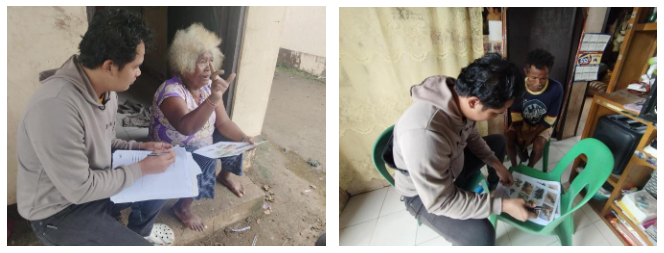
Beyond ecological metrics, the study conducted semi-structured ethnobotanical surveys with 30 married Dumagat respondents (aged 30 and above; 53% male, 47% female). With 67% of respondents attaining elementary-level education and 20% being out of school, the findings emphasize that traditional knowledge regarding wild seaweeds is primarily transmitted orally and through hands-on community practices.
The survey revealed that wild seaweeds serve as vital supplemental food, natural traditional medicine, and cultural symbols for the Dumagat people. Quantitative metrics—including Use Value (UV), Relative Frequency of Citation (RFC), and Percent Fidelity Level (%FL)—identified Caulerpa racemosa (sea grapes or lato) as the most versatile, utilized, and valuable species within the local indigenous ethnobotanical framework.
Bridging Science, Culture, and Coastal Management
The findings provide an empirical baseline for future marine spatial planning, biodiversity conservation, and sustainable resource management along the coastal landscapes of eastern Isabela. By documenting both ecological structures and indigenous traditions, the Institute of Fisheries continues to demonstrate its commitment to science-based coastal governance, biodiversity protection, and the preservation of local cultural heritage.
Content and Photo Credits: Institute of Fisheries